
Showing posts with label Cars. Show all posts
Showing posts with label Cars. Show all posts
Tuesday, February 2, 2010
Checker Cab
Manufactured by the Checker Motors Co. of Kalamazoo from 1956 to 1982, the Checker "Marathon" was THE New York City taxi for roughly 40 years. The last Checker taxi, with nearly 1,000,000 miles, was retired from New York City streets in 1999. Today our yellow cab fleet may be more diverse - with Toyotas, Hondas, Fords, Chevys and even some hybrid varieties - but they just don't have the "character" of the Checker models. Fabriano paper, 140 lb., 9" x 12", watercolor, pen & ink, casein.


Tuesday, July 21, 2009
"Pontiac Service"
 Just finished this yesterday. I've had this photo in my archive for several years, thinking it might eventually serve as a subject for painting. However, with the recently announced demise of the Pontiac line, slated for 2010, I felt compelled to tackle it. Although recent Pontiacs have been less-than-inspiring autos, older models often proved among the best-designed Detroit products. The stylish variations on their hood ornaments, some rendered in sleek, Deco-inspired chrome and Lucite, are especially appealing (and collectible). It's a shame GM's ineptitude has killed one of most significant U.S. auto marques. Watercolor, pen & ink, 9" x 12", Fabriano paper.


Monday, March 23, 2009
V8
There's been a lot of talk lately about disappearing car marques, including Pontiac, Saturn, and now Saab. If they are erased from the market it wouldn't be the first time a shakedown in the auto world has killed off venerable brands. Studebaker was one of the old manufacturing companies in the U.S., starting as a wagon maker in 1852. As World War II ended Studebaker seemed poised to be a leader in the auto sales race, preparing well in advance with new models and innovative designs. Indeed, one of their advertising slogans was "First by far with a post-war car." But the 1950s brought cut-throat competition in the industry as Ford and General Motors dominated sales. Numerous car companies failed during this period, including Nash, Hudson, Packard (which merged with Studebaker in 1954), and Crosley. Ironically, Studebaker was a victim of some of the same ills afflicting Detroit's "Big Three" today: high labor costs, high pension costs for retirees, quality control problems, and strong competition from other producers.
Studebaker Transtar pickup truck, V8 logo, rusting away in Vermont. Sennelier 9.5" x 4.5" landscape paper, 140 lb., watercolor, pen & ink.


Studebaker Transtar pickup truck, V8 logo, rusting away in Vermont. Sennelier 9.5" x 4.5" landscape paper, 140 lb., watercolor, pen & ink.

Wednesday, December 3, 2008
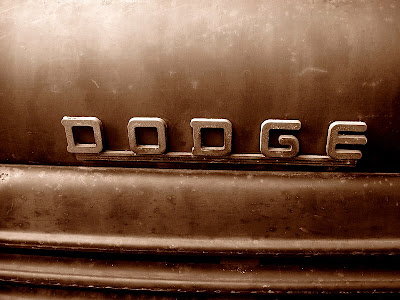
Dodge
This old Dodge pickup truck sits abandoned in one of the barns at Scott Farm. It's a late 40s/early 50s model and has likely been parked here for a long time. Still, it's amazing how well the body has held up with its cab exposed to the harsh Vermont winters. Are you familiar with the recent bestseller, The World Without Us, in which Alan Weisman examines "how our planet would respond without the relentless pressure of the human presence?" Basing his conclusions on extensive research, he speculates on how long it would take for our buildings, infrastructure, and other man-made items to decay. Obviously these old Detroit-made behemoths of steel would take many years to rust away and fall apart!


Friday, April 25, 2008
DMV
 Yesterday I took a day off to renew my driver's license at the Division of Motor Vehicles (DMV). And, since our cars are registered and garaged in Connecticut, we decided to drive out to Danbury (the kids are on Spring Break) and make a day of it. Of course a trip to the DMV, regardless of your state of residence, can potentially prove among life's most onerous tasks. With long lines, disgruntled patrons, and surly employees, the DMV can become a black hole, sucking away hours of one's time - like waiting for the cable guy or a telephone repairman to show up when . Television shows have lampooned the DMV for decades. The Simpsons, in which no institution is ever spared from satirical barbs, has embodied the very essence of the surly DMV employee in Selma and Patty Bouvier, Marge Simpson's sisters.
Nevertheless, my experience at the Danbury DMV yesterday defied all expectations and stereotypes. I was in and out in under 15 minutes and the staff was actually pleasant. The woman who took my picture and presented the new license was incredibly friendly - so friendly, in fact, that I told her she deserved an award for "Most Friendly DMV Employee." She acted genuinely touched and I'm guessing that she rarely receives compliments on the job, dealing instead with unhappy drivers who want to be anywhere other than the DMV. In the end, it took us longer to find the DMV building than renew the license. My wife and I were shocked.

Monday, March 17, 2008
License to Drive

Do I really want to share the streets of Manhattan with someone whose license to drive is based on a five-hour class? With cabs, trucks and buses weaving from lane to lane and jockeying for position as if 6th Avenue was the track out at Belmont, inexperienced drivers face a daunting task. Add a little rain, or worse, snow, and the cab drivers, many of them from warmer, snowless climes, make the streets a demolition derby. When I first arrived in NYC nearly ten years ago, I navigated the streets rather nervously - and I considered myself an experienced driver who had even handled large ice delivery trucks during summer breaks from college. Now, on the rare occasions I actually get behind the wheel of a car, I'm quite comfortable in City traffic. Simply drive defensively and assume everyone is trying to hit you!
During my first year in Manhattan I was amazed at how little one needed to use a car. In fact, I could sometimes go three and four months without driving. Between cabs and public transportation a car really isn't necessary. And with free parking at a minimum and subject to numerous rules and "alternate side of the street" routines for street cleaning, having a car in the the city is truly a nuisance. And how many of us can afford $300+ a month for a secure garage space? So it's no surprise than many people keep their cars outside of NYC (as we usually have over the years) or they simply don't own a car. Many of our friends just rent a car if they need one for a weekend getaway or vacation. I'm also surprised at the number of people who simply don't have driver's licenses, a situation entirely antithetical to the auto-crazy environment which defines nearly all of this country. These residents, usually older, grew up in New York, relied on public transportation or other family members, and never wanted to take on the expense or stress of securing a license. Surprisingly, I also have friends my age and younger who find themselves in the same situation.
In the end, the best means of transportation in New York City is by foot. It's been estimated that New Yorkers walk far more than the average American, and I believe it. A mile or two for our family is an easy trip. (Accustomed to walking long distances, the kids managed a four-mile mountain hike in Vermont last October without complaint.) On Saturday we walked from Symphony Space on Broadway at 96th Street down to 72nd Street, enjoying the mild weather and parade of people. In suburbia I've known people who will drive from one end of a mall to the other just so they don't have to walk the length of the mall to reach a store. How wasteful - in so many ways!
Friday, July 27, 2007
"What's Good for General Motors is Good for the U.S."
Yesterday's post started me thinking about why some people become wed to specific automobile brands in the way that my family gave their heart to Ford. I honestly think that if my father had won a Pontiac or even a Cadillac in a contest, he'd run down to the Ford dealership and trade it in on a new Taurus. What inspires that kind of devotion and, in many cases, a visceral response? Why do I go weak in the knees when I pass an Austin-Healey or Triumph? I'm not familiar with the psychological analyses of car ownership, but no doubt there's a significant body of literature out there addressing the subject.
What we're more likely familiar with, however, are the "class" connotations inherent in owning a particular brand of car. Here in money-crazed Manhattan, that's especially true; one regularly sees the newest, flashiest and sportiest cars available. It's not unusual to see a Ferrari, Aston-Martin, Bentley, or even a Maybach. But what force "drives" these purchases?
 Looking back to the 1950s and 60s when there were fewer choices for American consumers, the new car spectrum tended to be more stratified, often defined by where one lived and worked. At the time, General Motors was the largest industrial corporation in the world and sold the lion's share of cars in the U.S. (GM was so large, in fact, that impressions of the company in the 1950s are usually shaped by the oft misquoted words of Charles E. Wilson, who served as CEO of GM from 1941 to 1953, and as Secretary of Defense under Eisenhower from 1953 to 1957: "What's good for General Motors is good for the United States," he said.) In his wonderful book The Fifties, David Halberstam addresses this topic and points out that one usually bought a GM car based on one's position in the class system of the day. Blue-collar workers, for example, drove Chevys; white-collar families bought Pontiacs and, with a promotion or pay raise, might move up to a Buick. Oldsmobile tended to be the car of choice for doctors and lawyers, while executives opted for Cadillacs.
Today, with easier credit terms, the option of leases, and wider model selection, the auto-buying scene is a bit more fluid. Still, those old loyalties continue to play a role in our purchasing habits in the same way we develop brand loyalty to more mundane consumer goods. Just last month my father went out and bought a Ford Fusion, in the same color as the Taurus he traded in . . . despite my advice that he look into a more reliable Honda Civic or Accord. (Note my own brand loyalty and prejudice that a Honda would automatically prove "more reliable.")
My wife and I recently started talking about purchasing a new car at some point in late 2007 or early 2008. We need something that will hold the kids as they get bigger and allow us to take longer and more frequent car trips in comfort. Naturally I suggested a Honda, perhaps a CRV or Element. My wife, however, grew up with Volvos and suggested a Volvo Cross Country station wagon. (She even gave one a test-drive earlier this week!) It'll be interesting and fun to see what we eventually drive home. Some people loathe the car-buying experience . . . people like my parents. But I actually enjoy it . . . the hunt for just the right vehicle, one that will satisfy one's practical nature and elicit that visceral response.
Subscribe to:
Posts (Atom)


